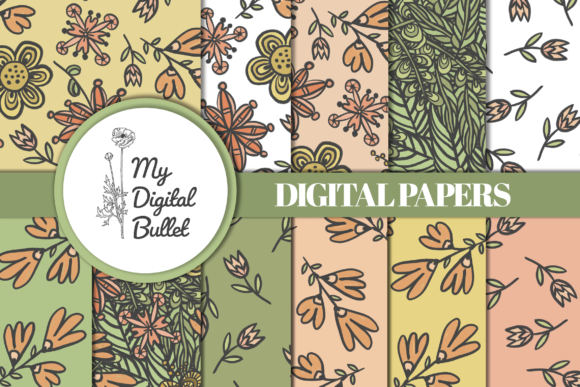
The Art and Science of Seamless Patterns Design: From Concept to Continuous Visual Flow
Patterns surround us. They appear in the weave of fabrics, the arrangement of tiles on a floor, the wallpaper on a screen, and the textures that fill digital illustrations. Yet not all patterns are created equal. The difference between a pattern that feels fragmented and one that flows effortlessly often comes down to a single defining quality: seamlessness. Seamless patterns design represents a discipline where repetition becomes invisible, where edges dissolve, and where a motif can extend infinitely without revealing where it begins or ends.
Understanding this field requires more than knowing how to tile an image. It involves grasping visual rhythm, mathematical spacing, edge continuity, and the psychological comfort that uninterrupted repetition provides. Whether someone is a textile designer preparing fabric rolls, a web developer building tiled backgrounds, or a surface pattern artist creating gift wrap, the principles remain consistent. The goal is always the same: make the join disappear.
What Makes a Pattern Truly Seamless
At its core, a seamless pattern is one where the repetition unit—often called a tile or repeat block—connects to itself on all four sides without visible interruption. When placed side by side and stacked vertically, the tiles merge into a continuous field. The human eye cannot detect where one tile ends and the next begins. Achieving this demands careful edge management and an understanding of how elements interact across boundaries.
Designers working in seamless patterns design frequently speak of the "edge problem." An element placed near the left edge of a tile must continue onto the right edge at the exact same vertical position. Similarly, anything touching the top edge must reappear at the bottom. When handled correctly, a half-flower on one side meets its other half on the opposite side, forming a complete bloom across the seam. This technique, known as offsetting, forms the technical backbone of the craft.
Offset and Wrap Techniques
The most common method for creating seamless repeats involves splitting the design canvas. Imagine a square tile. By shifting half the content horizontally and vertically, the designer moves the seam lines to the center of the composition rather than the edges. This allows for natural blending across what were previously hard borders. Any awkward gaps or overlaps become visible in the middle of the canvas, where they can be painted over, cloned, or adjusted manually.
Digital tools have simplified this process considerably. Software like Adobe Illustrator, Affinity Designer, and Procreate offer pattern preview modes that display the tile repeating in real time. As the designer draws on one tile, the mirrored instances update instantly, revealing how the pattern behaves in repetition. This immediate feedback loop transforms what was once a painstaking manual calculation into an intuitive creative flow.
Applications That Rely on Seamless Pattern Integrity
The reach of seamless patterns design extends across industries in ways that many consumers never consciously notice, yet they feel the effects. A poorly joined pattern on a dress catches attention for the wrong reasons. A misaligned wallpaper seam disrupts the ambiance of a room. A website background that tiles awkwardly cheapens the user experience. Seamlessness, in this sense, functions as a marker of quality.
Textile and Fashion Industry
Fabric printing demands absolute precision in pattern repeats. A single misalignment across a seam line can render yards of material unusable. Designers in this space must account for fabric width, print cylinder circumference for rotary printing, and the scaling factors involved in digital textile printing. The pattern must not only be seamless in its digital form but must remain so after stretching, cutting, and sewing. This is why textile designers often work with multiple repeat sizes and test physical swatches before committing to production runs.
Interior Design and Surface Coverings
Wallcoverings, floor tiles, countertop laminates, and upholstery fabrics all depend on seamless repeats. In these contexts, the pattern must work at architectural scales. A motif that looks balanced on a screen may feel overwhelming when covering an entire wall. Designers must consider scale modulation—creating patterns that read well both up close and from across a room. The concept of "repeat drop" becomes relevant here, where offsetting the pattern horizontally between rows prevents the eye from detecting vertical columns of repetition.
Digital Media and User Interface Design
Web designers and app developers use seamless patterns for backgrounds, loading screens, section dividers, and branding elements. A tiled background image must remain lightweight for performance reasons, often a small square repeated via CSS. If the seam is visible, the entire interface feels amateurish. Beyond static backgrounds, seamless patterns appear in game design textures—the grass that stretches to the horizon, the brick walls characters run past, the starfields scrolling behind spaceships. In these dynamic environments, seamlessness must hold up under motion and parallax effects.
Packaging and Product Design
Gift wrap, shopping bags, tissue paper, and box liners frequently feature repeating motifs. Here, the pattern must accommodate folds, creases, and cuts. A strong seamless patterns design approach ensures that no matter how the paper is torn or wrapped, the decorative quality remains intact. Product designers also apply seamless textures to physical goods—phone cases, notebook covers, ceramic mugs—where the cylindrical or irregular surface adds complexity to how the repeat behaves.
Characteristics That Define Effective Seamless Patterns
Not every seamless repeat succeeds aesthetically. Technical correctness—the absence of visible seams—represents only the baseline. Truly compelling patterns exhibit additional qualities that elevate them from functional to memorable.
Balanced Visual Weight
A pattern must distribute its elements evenly across the tile. If one corner is densely packed with detail while another remains sparse, the eye fixates on the imbalance. When repeated, this creates an unintended grid of dense and empty zones. Designers address this by stepping back frequently, blurring their vision slightly, and observing where the eye travels. Tools that display the pattern in grayscale help assess tonal distribution without the distraction of color.
Rhythm and Flow
Patterns possess rhythm in much the same way music does. The spacing between motifs, the alternation of large and small elements, and the directional cues created by curves and lines all contribute to how the pattern feels. A pattern with a strong diagonal flow carries the eye continuously across the surface. A more static, grid-based layout conveys stability. Understanding these rhythmic properties allows designers to match pattern character to its intended context—energetic for activewear, calm for bedding, structured for corporate branding.
Scale Awareness
The size of the repeat tile relative to the motifs it contains dramatically affects the final appearance. A small repeat with tiny elements creates texture rather than distinct pattern. A large repeat with bold motifs makes a statement but risks obvious repetition if not carefully managed. Many professional pattern collections include multiple scale variations of the same design, recognizing that a pattern suitable for a phone case may need adjustment for a bedspread.
The Role of Color in Seamless Repetition
Color choices interact with seamlessness in subtle but important ways. High-contrast edges near tile boundaries draw attention to seams, undermining the seamless effect even when technically correct. A dark shape ending abruptly against a light background at the exact edge of a tile can create a visible line when repeated. Designers mitigate this by feathering edges, avoiding sharp cutoffs, and ensuring that boundary areas contain transitional tones rather than stark juxtapositions.
Color reduction—limiting a pattern to a defined palette—serves both aesthetic and production purposes. Screen printing requires separate screens for each color, making palette efficiency a cost concern. Digital printing offers more flexibility, but restrained color schemes often yield more sophisticated results. The most enduring patterns across design history tend to use economical palettes where each hue performs multiple roles throughout the composition.
Workflow Considerations for Pattern Creators
Developing proficiency in seamless patterns design involves more than mastering software. It requires a workflow that balances creative exploration with technical verification. Many experienced designers follow a phased approach.
They begin with motif development—sketching, photographing, or digitally illustrating the individual elements that will populate the pattern. These motifs are isolated as separate assets, often with transparent backgrounds, allowing for flexible arrangement. The next phase involves building the repeat tile, placing motifs strategically, and applying the offset technique to bridge edges. The final phase is testing—viewing the pattern at multiple scales, checking for unintended visual artifacts, and making micro-adjustments to spacing and orientation.
An often-overlooked step involves stress-testing the pattern in its intended context. A textile designer drapes the digital pattern onto a 3D garment model. A web designer loads the tile onto a staging page and scrolls aggressively. A surface designer applies the pattern to a curved mockup. These real-world checks catch issues that escape notice on a flat, bounded canvas.
Common Pitfalls and How Experienced Designers Avoid Them
Even skilled practitioners encounter challenges. One frequent issue is the "stamp effect," where a single distinctive motif appears too regularly, creating an obvious grid when repeated. The solution involves introducing variation—rotating the motif slightly, scaling some instances up or down, or adding secondary elements that break up the uniformity.
Another pitfall is edge crowding. When too many high-interest elements cluster near tile boundaries, the seam area becomes visually dense, creating unintended lines in the repeated pattern. Distributing focal points more evenly across the tile and keeping boundary areas slightly quieter resolves this.
A subtler problem involves unintended directional bias. A pattern that flows strongly left-to-right can feel unsettling when viewed in large expanses, as if the surface itself is tilting. Introducing counter-directional elements, or designing patterns with multi-directional balance, prevents this sensation. The best seamless patterns reward the eye no matter which way the surface is oriented.
Educational and Creative Value of Pattern Design
Educators in art and design programs often introduce seamless patterns design as a gateway to understanding symmetry, repetition, and modular thinking. The constraints of the repeat tile teach discipline—every mark on one edge must be resolved on the opposite edge. Yet within these constraints, infinite creative possibilities exist. Students learn that limitations often catalyze innovation rather than restrict it.
For hobbyists and independent creators, pattern design offers a low-barrier creative outlet with real commercial potential. Platforms that sell digital assets, print-on-demand products, and fabric designs allow individual designers to monetize their pattern collections. The technical skills required are learnable, and the tools have become increasingly accessible. A person with a drawing tablet and an understanding of the offset method can produce professional-quality patterns within weeks of dedicated practice.
How Researchers and Engineers Engage with Seamless Tiling
Beyond artistic domains, seamless patterns design principles appear in scientific and engineering contexts. Researchers studying natural structures—honeycomb, fish scales, leaf venation—analyze how biological systems achieve functional seamlessness. Materials scientists developing synthetic surfaces with repeating microstructures apply tiling logic to ensure consistent performance across a surface. Architects designing modular building systems grapple with the same edge-continuity challenges that fabric designers face, translated to three dimensions and structural loads.
Procedural generation, a technique used in computer graphics and game development, automates seamless texture creation through algorithms. Perlin noise, Voronoi diagrams, and other mathematical functions produce naturally tiling textures without manual edge-blending. Understanding these computational approaches enriches the broader conversation about what seamlessness means and how it can be achieved through different methods.
Evolving Tools and Future Directions
The tools available for seamless pattern creation continue to advance. AI-assisted design platforms can now generate pattern variations, suggest color palettes, and even complete partial repeat tiles. While these tools accelerate production, they also raise questions about originality and the designer's role. A pattern generated entirely by an algorithm may lack the intentionality and cultural resonance of one crafted by a human hand. The emerging best practice treats AI as a collaborator—handling repetitive edge-blending tasks so the designer can focus on conceptual and aesthetic decisions.
Another development involves interactive patterns that respond to user input or environmental data. Imagine a wallpaper pattern that subtly shifts color based on room temperature, or a website background that reorganizes its motifs in response to cursor movement. These dynamic applications still depend on seamless tiling at their foundation, but they add a temporal dimension to what has traditionally been a static art form.
Practical Considerations for Business Owners and Clients
Business owners commissioning pattern designs benefit from understanding the basics of seamless patterns design. Clear communication about intended use—fabric, paper, screen, large-format printing—helps designers make appropriate technical choices. Knowing the production method matters: screen printing has different requirements than digital printing. Understanding that a pattern designed for a small product may not scale successfully to a large one prevents costly revisions.
Licensing considerations also enter the picture. A pattern created for a limited-edition product run may carry different usage rights than one intended for mass production. Both designers and clients should establish these terms upfront, ideally in written agreements that specify exclusivity, territory, duration, and application scope.
The value of a well-executed seamless pattern extends beyond its immediate visual appeal. It signals attention to detail, technical competence, and respect for the end user's experience. In competitive markets where products sit side by side on shelves or screens, the difference between a pattern that flows and one that jars can influence purchasing decisions at a subconscious level. Understanding this, successful brands invest in pattern quality as a form of silent communication about their standards.