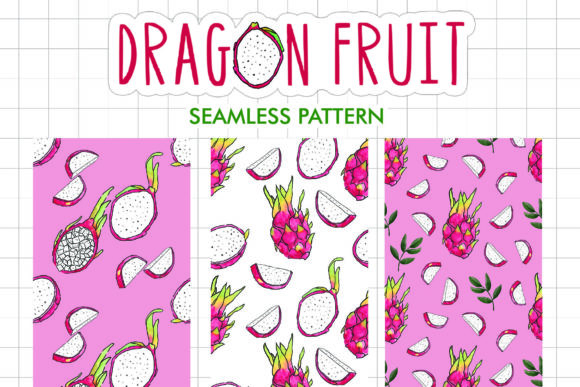
Dragon Fruit Seamless Patterns: What Actually Works and What Will Cost You Time
You found a vibrant set of Dragon Fruit Seamless Patterns and the preview looks incredible. The deep magentas, the speckled greens, the way each slice repeats without a visible edge — it is exactly the tropical accent your project needs. But before you download the files and start applying them across your surface designs, product mockups, or textile prints, there are a few things that experienced designers wish someone had told them early on. The wrong choices here do not just look amateurish. They can stall an entire product launch or force you to redo work you thought was finished.
What Are Dragon Fruit Seamless Patterns and Why They Keep Showing Up
A seamless pattern is a tileable image that repeats without visible borders or breaks. When the subject is dragon fruit — also called pitaya — the visual payoff is striking. The cross-section slices with their white flesh and tiny black seeds, the bright pink outer skin, and the layered green scales create a graphic contrast that works for summer branding, wellness packaging, swimwear, stationery, and even phone cases. Dragon Fruit Seamless Patterns have become a go-to resource for creators who want something between botanical and playful, without drifting into overly sweet or childish territory.
Interest in these patterns spans a wide range. A small business owner might use them on fabric for handmade accessories. A blogger could apply them as website section dividers. An educator might print them for classroom decor. A marketer building a smoothie bar campaign might wrap them around social media templates. The versatility is genuine, but only if the files are prepared correctly and used in the right context.
The Mistake of Ignoring Resolution and File Format Before You Even Start
One of the most frequent missteps people make is grabbing the first attractive Dragon Fruit Seamless Pattern pack they see and assuming it will work everywhere. It will not. A pattern designed for digital screens at 72 DPI will look blurry and unprofessional when printed on fabric at 300 DPI. Conversely, downloading a massive 600 DPI file for a website background will slow page load times and frustrate visitors before they even see your design.
What happens when you skip this check? The pattern that looked crisp on your monitor turns into a pixelated mess on a tote bag. Or you upload a 40-megabyte tile as a repeating background for an online store and watch your bounce rate climb because the page takes eight seconds to load. Neither outcome reflects your actual skill — it is simply a mismatch between the file and its final destination.
Better approach: Before downloading or purchasing any pattern set, confirm the resolution. For print work, look for at least 300 DPI and check that the file dimensions match your intended output size. For digital use, 150 DPI is often sufficient, and you can optimize further with compressed formats like JPEG or WebP. If the seller does not list resolution details, ask. If they cannot answer clearly, consider that a warning sign.
Assuming Every Seamless Pattern Is Actually Seamless
The term "seamless" gets thrown around loosely in marketplaces and freebie sites. True Dragon Fruit Seamless Patterns tile perfectly in all four directions without a visible join line. A surprising number of so-called seamless files fail this test when you place them side by side. You might notice a faint vertical stripe where one tile ends and the next begins. With a busy pattern like dragon fruit slices — full of seeds, gradients, and overlapping shapes — those inconsistencies can hide during a quick preview and become glaringly obvious once printed or scaled.
This ruins wallpaper projects, fabric yardage, and wrapping paper designs especially. Imagine printing several meters of custom fabric only to find a rhythmic break every twelve inches. Returning that fabric or fixing the file after production has started is far more expensive than verifying the pattern on day one.
How to avoid this: Open the pattern tile in your design software and set up a 3×3 grid using the tile. Zoom in and scan the seams. Offset the pattern by 50% horizontally and vertically to check for hidden breaks. A legitimate seamless tile will hold up under both tests. If you are buying from a marketplace, look for reviews that specifically mention seamlessness. Comments like "used this for Spoonflower fabric and it printed perfectly" carry more weight than "looks pretty."
Overlooking Color Profiles and Print-Ready Settings
Dragon fruit lends itself to intense, saturated colors — hot pinks, deep greens, pure whites. That vibrancy is part of the appeal. But color shifts between screen and paper can turn your tropical statement into a muddy disappointment. Many beginners download RGB pattern files and send them straight to a print-on-demand service without converting to CMYK. The result is often dulled pinks that look more like faded coral and greens that shift toward brown.
The financial and emotional cost here is real. A batch of twenty tote bags or a limited run of notebooks arrives looking nothing like the mockup. Customers notice. Returns happen. Reviews suffer.
Practical correction: If your project is destined for physical products, check whether the pattern files come in CMYK or at least provide color profile information. Work in CMYK from the start when possible, or soft-proof the conversion before committing to a large order. Some pattern sellers offer both RGB and CMYK versions — prioritize those who do. And always order a single test sample before scaling up.
Forgetting About Scale and Repeat Size in Real-World Applications
Pattern scale is one of the most overlooked details in the entire design process. A dragon fruit motif that measures two inches across might look delicate and balanced on a phone case, but the same tile on a bedsheet will feel chaotically small and busy. The opposite happens too: a large-scale hero repeat that works beautifully on a wall mural becomes unrecognizable when shrunk onto a business card.
Scale mismanagement changes the entire visual hierarchy of a design. What was supposed to be a subtle background becomes a dominating visual noise. What was meant as a bold statement shrinks into an indistinct speckled texture.
How experienced designers handle this: Before finalizing a Dragon Fruit Seamless Pattern for any project, test the repeat size at the actual dimensions of the end product. Most design software lets you preview at 100% scale. If the pattern feels too large or too small, check whether the file can be resized without losing quality. Vector-based patterns offer the most flexibility here; raster patterns have hard limits on scaling up. When buying, note whether the listing specifies repeat tile dimensions, and compare those to your intended output.
Neglecting Usage Rights and Licensing Terms
This mistake is less visual but potentially more damaging. People download or purchase pattern packs and assume they can use them commercially on any product, in any quantity, forever. The reality varies widely. Some Dragon Fruit Seamless Patterns are for personal use only. Some allow commercial use but limit the number of end products. Some prohibit use on print-on-demand platforms entirely. Others require attribution or have terms that change if you modify the file.
Using a pattern outside its license can trigger takedown notices on Etsy, Shopify, or Amazon. For small business owners who have built listings, collected reviews, and invested in marketing, losing a product page overnight is not just inconvenient — it cuts directly into income.
What to check before purchasing or downloading: Read the full license, not just the summary. Look specifically for print-on-demand permissions if you sell through third-party manufacturers. Confirm whether extended commercial licenses are available and what they cost. Some designers are open to custom licensing if you reach out directly. Keeping a folder of license documents alongside your pattern files is a habit that saves headaches later.
Relying on a Single Pattern Without Considering a Coordinating Set
A single dragon fruit repeat can work in isolation, but many projects benefit from a family of patterns. The most polished brand applications — packaging lines, fabric collections, social media templates — often use a primary pattern, a secondary coordinate, and a blender. Someone who only downloads the main Dragon Fruit Seamless Pattern without considering how it pairs with solids, stripes, or simpler dot textures may find their project looking one-dimensional.
This is especially noticeable in product ranges. A collection of stationery that uses the same exact pattern on notebooks, pencil cases, and gift wrap can feel repetitive rather than cohesive. A small amount of variation creates a more intentional, curated look.
Better strategy: Look for pattern bundles that include complementary designs — perhaps a scattered seed texture, a tonal green geometric, or a subtle dragon fruit silhouette repeat. Even if you only use the hero pattern predominantly, having a secondary option for liners, inside covers, or accent panels elevates the final product without requiring extra design work from scratch.
Applying Patterns Without Testing How They Interact With Typography and Layout
A visually dense dragon fruit pattern has a lot going on — seeds create texture, the pink areas create pools of color, and the green scales add directional movement. When you drop this behind text, logos, or product descriptions, readability can collapse. White type can disappear over the pale flesh areas. Dark type can clash with the deep pink and green zones. The pattern that looked perfect in isolation suddenly undermines the message it was supposed to support.
This mistake is most visible on websites, packaging labels, and promotional materials where information must compete with the background. If customers cannot read the product name or the sale details, the design has functionally failed.
How to fix it: Use overlay techniques to create readable zones. Add a semi-transparent layer between the pattern and the text. Choose solid blocks for critical information rather than placing it directly over the busiest parts of the repeat. Test readability at multiple screen sizes and under different lighting if the design will be printed. A pattern that works as a hero element on one part of a layout may need to be subdued or replaced in the functional areas.
Skipping the Real-World Sample Check
Digital mockups are helpful, but they are not reality. The texture of paper stock, the absorbency of fabric, the coating on a phone case — all of these affect how a Dragon Fruit Seamless Pattern actually looks. Colors that pop on a backlit screen can lose their energy on uncoated paper. A pattern that seems balanced digitally might feel off-center when you hold a physical object in your hands.
People who skip physical sampling, especially when ordering inventory, often discover the discrepancy after the full production run. At that point, the cost of fixing the issue multiplies.
Avoiding the regret: Order one prototype or print a section at actual size on the intended material. Check it in natural light and under indoor lighting. Feel how the pattern sits in your hand. This is the truest test of scale, color, and overall impression. The small upfront cost of a sample is trivial compared to the expense of discarding or discounting finished products.
Choosing the Wrong Source for Your Pattern Files
There is an enormous difference between a pattern carefully crafted by a professional surface designer and one auto-generated by a tool. Both exist, and both can look appealing in thumbnail previews. The quality gap emerges in the details: how the edges of each dragon fruit slice are treated, whether the seeds are correctly placed within the flesh, if the color gradients feel natural or algorithmic.
A poorly constructed pattern can have subtle artifacts, inconsistent lighting across repeats, or elements that look fine at 20% zoom but reveal odd cloning marks at full resolution. For hobbyists making a one-off project, these flaws might not matter. For anyone selling products or representing a brand, they degrade the perceived value of everything associated with the design.
Smarter sourcing: Vet the designer or marketplace. Look for portfolios with consistent quality. Read reviews that mention end-use and durability. If the price seems unusually low for a large bundle, ask yourself how much effort realistically went into each file. Spending a little more on a high-quality, well-documented set of Dragon Fruit Seamless Patterns almost always delivers better results than chasing the cheapest option and spending hours fixing what you downloaded.
Practical Steps Before You Commit to Any Dragon Fruit Pattern
Take a few minutes to run through a quick checklist before you download, purchase, or apply a pattern. These steps prevent the majority of problems that surface later.
- Confirm the resolution and dimensions — match them to your output medium whether digital or physical.
- Test the seamlessness — tile the file and zoom in to check all four edges for breaks or color mismatches.
- Verify the color profile — RGB for screens, CMYK for print. Confirm what the file actually provides.
- Check the license — ensure it covers your intended use, platform, and product quantity.
- Assess the scale — preview at actual output size and decide if the repeat feels appropriate.
- Request or download a sample tile — many sellers offer a freebie or low-resolution preview for testing.
- Plan for coordinating elements — identify whether you need secondary patterns or solid companions.
Dragon Fruit Seamless Patterns bring energy, color, and a touch of the unexpected to creative work. When chosen carefully and applied with attention to the details that matter, they can lift a project from generic to memorable. The patterns themselves are only half the equation. Knowing how to evaluate, prepare, and place them is what separates results you are proud to share from those you quietly redo.